Featured Articles
PG Calc publishes monthly articles on the latest topics in planned giving.
PG Calc QCD Survey: Many Charities Report Closing CGAs Funded With a QCD
-
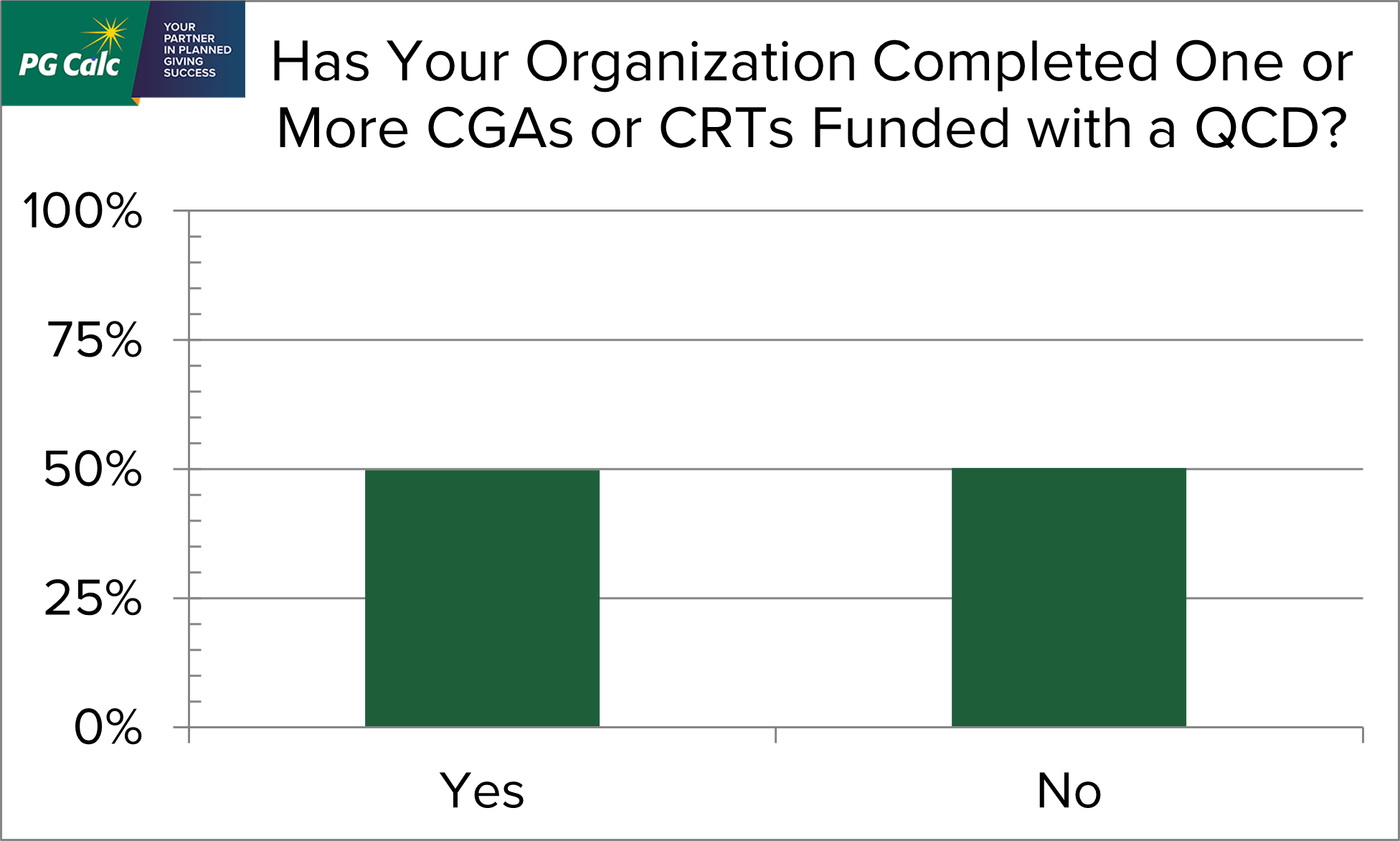 A new gift planning opportunity became available at the beginning of this year thanks to the Legacy IRA Act that passed late last December: funding a charitable gift annuity (CGA) or charitable remainder trust (CRT) with a qualified charitable distribution (QCD) from one’s IRA. Gift planners were rightfully excited to have a new gift plan to talk about with their donors. However, the new gift plan’s many requirements raised doubts about how popular it would be. Who would make these gifts? Now that we are most of the way through 2023, the QCD for life income plan’s place in planned gift fundraising has become clearer.
In their interactions with clients, our Client Services and Gift Administration teams have noticed a recent increase in the number of new CGAs funded with a QCD. This pattern piqued our interest. To investigate the popularity of this new gift option further, we sent out a survey to a broad fundraising audience. We summarize our results below.
Measuring the Success of Your CGA Program: The Case for Maintaining Current Market Values for All Charitable Gift Annuities
-Charitable gift annuities (CGAs) are designed to be the split-interest gift for any donor. The basic premise is that the donor contributes cash or marketable securities to a charitable organization, and the charity promises to make payments to the donor for the rest of his or her life. The donor receives a charitable income tax deduction at the time of the gift, and some portion of the original principal remains at the donor’s passing.
That all sounds great, right? A classic “win-win-win” arrangement, and in fact, most charitable gift annuities result in a significant portion of the original principal as the residuum. When a charity has a robust gift annuity program, there can be enormous financial rewards from the ongoing stream of CGA terminations. But we’ve all heard the other side of the story as well. We’ve all heard of examples where the gift corpus becomes completely used up, and in fact, the charity ends up kicking in money from general funds to continue making payments to an annuitant who lived beyond their original life expectancy. We call these “underwater gift annuities,” and they actually end up with negative dollar benefits.
So, what is the sum total benefit of this gift annuity venture from the charity’s perspective? Put simply, how does the charity even begin to measure the success of their CGA program?
Giving USA Report on Philanthropy: Is It the End of the World as We Know It?
-“Drop in Giving Among Steepest Ever,” screamed the Chronicle of Philanthropy headline. Other media piled on. The anodyne Associated Press led with, “Charitable Giving Drops, Only the Fourth Time in 40 Years.” And the redoubtable Barron’s reported, “Charitable Giving Falls for the First Time Since the Financial Crisis.”
Is this all just hyperbole? Or does it leave you wondering if it might be time to hang it up and consider a different career path? Don’t despair. At least not yet. The release last month of the 68th Giving USA Annual Report on Philanthropy (Giving USA Report), which reported a drop of 10.5% in giving last year, triggered the hoopla. The Report is an initiative of the Giving USA Foundation in collaboration with the Indiana University Lilly Family School of Philanthropy.
It’s too bad the Report has been reduced to a headline because, well beyond a simple scoreboard of giving, it also provides a wealth of useful information and interesting insights about the history of and trends in charitable giving in the United States.
Understanding Gift Tax and How to Minimize It
-While it may seem esoteric, understanding gift tax is very helpful if you’re working on a life income gift that benefits someone in addition to, or other than, the donor. In these situations, the donor is making two gifts: one to the charity and one to the income beneficiary, and this second gift may be taxable.
Analysis of the New ACGA Annuity Rates
-On April 22, 2022, Dave Ely, Chair of the American Council on Gift Annuities’ Rates and Regulations Committee, announced at the ACGA Conference that the ACGA would be increasing its suggested maximum annuity rates, effective July 1, 2022. We now know the details of the new rates, which the ACGA made public on June 2. The new rates replace the rates that became effective July 1, 2020. The ACGA’s decision to increase its suggested maximum gift annuity rates was triggered by the sharp rise in interest rates since the beginning of the year.
The Other Five of the Top Ten Lessons Learned from the Front Lines of Client Services
-The world of planned giving is complex and fascinating. It is squarely at the intersection of philanthropy and estate planning, but it also overlaps with the areas of law, taxation, investments, and human behavior. There are so many nuances and specialty areas of knowledge that the gift planning professional can easily become overwhelmed and lose sight of the core issues. We at PG Calc hesitate to say, “we’ve seen it all,” but in some ways, we have!
We produce software for gift planning and gift administration, and we provide a wide array of services ranging from consulting to web services. We thought it might be helpful to pause for a moment and share what we’ve identified as the top 10 lessons (this is the first installment of 5) in planned giving that we have learned over the 37 years of our company’s existence. These are not necessarily in order of importance or relevance, and of course, they represent only a tiny portion of the knowledge required for any modern-day gift planner.
Undeliverable or Uncashed is Unacceptable!
-Uncashed checks, or tax forms and checks returned undeliverable! These are some of the most frequent and frustrating challenges for administrators of life income gifts.
With outright gifts, you deposit a donor’s check or other form of donation, send an acknowledgement letter, enter the person into your database, and reach out periodically. You certainly try to keep up with people’s moves … but for life income gifts, the stakes are a bit higher. Your organization must make income payments on a scheduled basis.
What to do?
Five of the Top Ten Lessons Learned from the Front Lines of Client Services
-The world of planned giving is complex and fascinating. It is squarely at the intersection of philanthropy and estate planning, but it also overlaps with the areas of law, taxation, investments, and human behavior. There are so many nuances and specialty areas of knowledge that the gift planning professional can easily become overwhelmed and lose sight of the core issues. We at PG Calc hesitate to say, “we’ve seen it all,” but in some ways, we have!
We produce software for gift planning and gift administration, and we provide a wide array of services ranging from consulting to web services. We thought it might be helpful to pause for a moment and share what we’ve identified as the top 10 lessons (this is the first installment of 5) in planned giving that we have learned over the 37 years of our company’s existence. These are not necessarily in order of importance or relevance, and of course, they represent only a tiny portion of the knowledge required for any modern-day gift planner.
Never Surrender! (Or Surrender Now!) – The Relinquishing of Life Income Gifts
-One of the planned giving trends that has evolved in recent years is the voluntary termination of life income gift arrangements. While not a part of the original intent in the creation of these gift plans, surrendering the remaining lifetime income in these split-interest gifts has become popular for a number of reasons. Certainly, there are obvious benefits to the sponsoring charitable organizations – these terminations eliminate the charity’s ongoing liability for payments, and of course, they receive the remainder amounts sooner than otherwise would be the case – but there are also benefits to the donors who relinquish their interests.
A Practical Approach to Receiving IRA Bequest Distributions
-Collecting the funds, when a donor makes a charity the beneficiary of an IRA, can be challenging. There has been much discussion about IRA administrators who, with a few exceptions, require charitable beneficiaries to establish an IRA account to receive a distribution from the donor’s IRA, 401(k), 403(b), or other qualified plan.